



Glycol Dehydration at a Glance
Glycol dehydration removes water from wet natural gas using glycol solvents to help meet pipeline specifications and support downstream processing. Effective liquid and solid contamination control can help maintain glycol loop efficiency, support gas quality and reduce issues such as foaming, fouling and glycol carryover.
How Does Glycol Dehydration Work?
Glycol dehydration processes utilize glycol solvents to remove water from wet natural gas in order to meet pipeline quality specifications or condition the gas for condensate liquids removal.
The wet gas is contacted with lean glycol in the contactor tower. The rich glycol then flows to a regenerator, where heat separates the glycol and the water, regenerating the glycol for re-use. The water vapor exits the top of the regenerator to atmosphere while the lean glycol is recirculated back to the contactor in a recirculating loop.
Glycol Dehydration Process
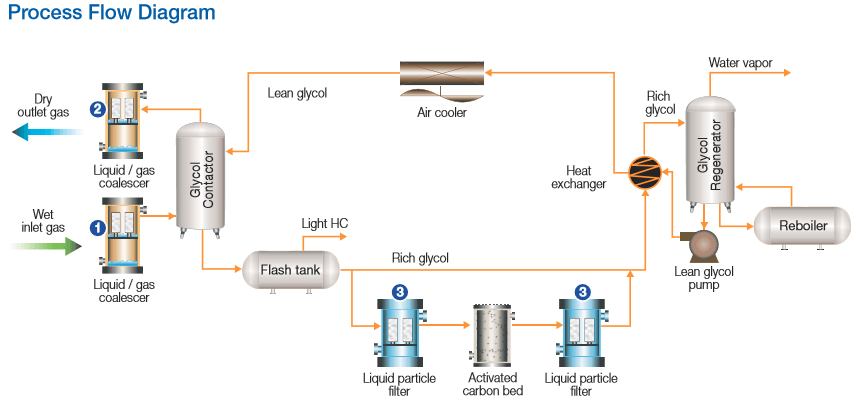
Glycol dehydration systems use glycol solvents to remove water from wet natural gas and support pipeline gas specifications.
What Does a Glycol Dehydration Plant Need?
Glycol dehydration plants are designed to:
- Achieve reliable treatment of wet gas streams
- Maintain process reliability and reduce downtime
- Deliver on-spec sales gas quality
- Minimize fouling and corrosion-related maintenance
Common Glycol Dehydration Challenges
| Challenge | Why It Happens | Pall Solution |
|---|---|---|
| Foaming, reduced production rates and high water-content sales gas | Hydrocarbon liquids and particulates can enter the glycol loop. KO pots, mesh pads, cyclonic devices and conventional filter-separators may not effectively remove aerosol-sized liquid hydrocarbon droplets or fine solids. | Use effective liquid and solid removal upstream of the contactor to protect the glycol loop from foaming and fouling. SepraSol™ Plus liquid/gas coalescers and Medallion™ HP liquid/gas coalescers support this application. |
| Foaming, poor dehydration performance and increased maintenance | Dirty glycol can foul the contactor, lean-rich exchanger, regenerator and reboiler. Fine corrosion products may not be adequately removed by filters affected by unloading, media migration, channeling or poor sealing. | Use effective solids control within the glycol loop. Absolute- and nominal-rated filter elements are available to reduce suspended solids to less than 5 ppmw, maintain glycol clarity and reduce related foaming and fouling. |
| Downstream glycol carryover | Glycol mechanical losses can pass from the contactor into the dry-gas stream. | Install high-efficiency coalescers downstream of the contactor to recover glycol mechanical losses and prevent downstream carryover. |
How Can Liquid/Gas Coalescers Support Glycol Dehydration?
Liquid/gas coalescers are used in glycol dehydration applications to help remove fine liquid aerosols and solids that can contribute to foaming, fouling and glycol carryover.
SepraSol™ Plus liquid/gas coalescers and Medallion™ HP liquid/gas coalescers provide 99.999% removal at 0.3 microns per the DOP test and 1 ppb downstream per the modified ANSI/CAGI-400-1999 test procedure. Both offer excellent foaming protection.
Recommended Filtration and Separation Solutions
Frequently Asked Questions
What is glycol dehydration?
Glycol dehydration uses glycol solvents to remove water from wet natural gas to help meet pipeline specifications and support downstream processing.
Why is glycol dehydration important?
It helps support gas quality, process reliability and efficient natural gas processing operations.
What causes foaming in glycol dehydration systems?
Hydrocarbon liquids and particulate contamination entering the glycol loop can contribute to foaming and reduced dehydration performance.
What is glycol carryover?
Glycol carryover occurs when glycol enters downstream gas streams and can affect downstream process performance.
Which filtration solutions are used in glycol dehydration systems?
Liquid/gas coalescers and glycol filters are used to help remove contamination and maintain glycol loop efficiency.
Improve Glycol Dehydration Performance
Contamination control can play an important role in maintaining glycol loop efficiency, supporting gas quality and reducing fouling-related maintenance.
Contact a Filtration Expert
Discuss glycol dehydration challenges, contamination control and filtration solutions with a Pall specialist.
Contact a Glycol Dehydration Expert