



What is shaping flavor innovation and processing?
From next-generation ingredients to increasing pressure for transparency and resilient sourcing, flavor manufacturers are responding to evolving consumer expectations, ingredient innovations and sourcing pressures. While individual flavor profiles may come and go, changes in ingredients, consumer expectations and sourcing continue to influence food and beverage innovation and manufacturing priorities.
As these forces influence ingredient selection, formulation strategies and production requirements, manufacturers may need to reassess how their processes support product consistency and established quality requirements across a growing range of flavor applications.

How can health-focused reformulation affect flavor processing?
Health-focused reformulation can change ingredient profiles, solubility, turbidity and other processing conditions, which may affect clarification and filtration requirements. Consumer interest in health and wellness remains a major influence on food and beverage innovation, with many manufacturers evaluating opportunities to reduce sugar and sodium while maintaining the taste experiences consumers expect.
At the same time, flavor remains a key purchasing driver. According to Mintel research, 52% of US consumers consider a product’s flavor more important than a clean label. The finding underscores the need to consider taste alongside reformulation and ingredient-positioning objectives.
Depending on the formulation, manufacturers may need to review clarification and filtration steps as part of the wider reformulation process.
Explore common flavor filtration challenges and solutions to learn more about considerations for particle removal, haze reduction and other processing requirements that may become relevant as formulations evolve.
What processing considerations come with new ingredients?
The discussion around alternative proteins continues to evolve beyond traditional plant-based products. Manufacturers are exploring fermentation-derived ingredients, hybrid formulations and emerging technologies that open new possibilities for food and beverage development.
The Institute of Food Technologists identifies precision fermentation as a potential route for producing high-value flavors, sweeteners and proteins that can be difficult to source sustainably through conventional methods.
These developments create opportunities for differentiation while introducing new formulation and manufacturing considerations. Raw-material variability, extraction methods and solvents can affect flavor-processing requirements, so filtration selection should be evaluated against the specific formulation and production objective.
As ingredient platforms continue to evolve, manufacturers may need to evaluate processing approaches for different flavor substances, solvents and formulation requirements. Review Pall flavor filtration capabilities for an overview of flavor applications and processing considerations.
How does transparency affect flavor development?
Consumers increasingly want to understand what products contain, where ingredients originate and how formulations support their priorities. Transparency now extends beyond ingredient declarations to include sourcing, processing and clearer product information.
Mintel highlights growing pressure on brands to maintain flavor impact while reducing artificial ingredients and to communicate ingredient science, provenance and safety more clearly.
For flavor manufacturers, the opportunity is to support innovation while communicating ingredient and sourcing information without oversimplifying formulation choices. Clear process documentation and defined quality requirements can also support consistent communication across development and manufacturing teams.
How do global and multisensory influences affect production?
Consumers continue to seek taste experiences inspired by global cuisines, regional ingredients and distinctive sensory combinations. Product development is increasingly drawing on the interaction of taste, aroma and texture rather than flavor alone.
Industry observers cited by the Institute of Food Technologists identify culinary authenticity, flavor mashups, functional botanicals and modern nostalgia as continuing influences on innovation.
The manufacturing challenge is to translate these experiences into products that can be produced consistently at commercial scale while preserving intended aroma, color and clarity requirements. Because these characteristics can be sensitive to processing, filtration choices should be matched to the composition of the flavor and the targeted separation task.
How can supply changes affect flavor processing?
Ingredient availability remains an important consideration for flavor manufacturers. Climate conditions, crop variability, disease and geopolitical disruption can influence supply chains and create sourcing challenges for key ingredients.
Mintel's long-term food and beverage outlook suggests that resilience and resourcefulness will remain important themes through 2030. Manufacturers will continue to evaluate sourcing strategies, ingredient alternatives and production approaches as supply conditions change. Citrus is one visible example, but ingredient variability can affect many flavor inputs. When a raw material or formulation changes, the associated clarification and filtration requirements may also need to be reevaluated. Explore flavor challenges and solutions to review considerations for particle, haze, wax and water removal.
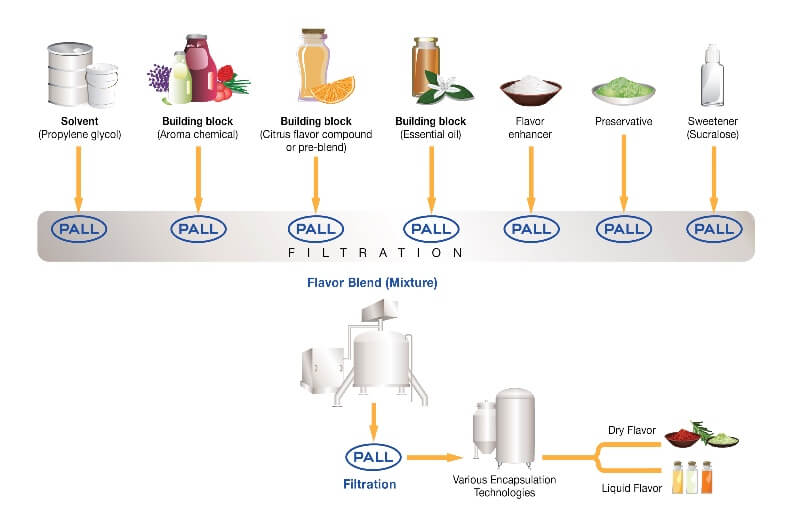
Flavor formulations may require different clarification, separation and filtration approaches depending on ingredients, process conditions and quality requirements.
What do changing flavor trends mean for manufacturers?
Specific flavor profiles change over time, while broader considerations such as health-focused reformulation, transparency, next-generation ingredients, global inspiration and supply resilience continue to influence how products are developed and brought to market.
For manufacturers, responding to these shifts requires attention to both formulation and process design. Flavor substances can present different filtration challenges based on raw materials, extraction methods, solvents and the sources of turbidity. Depending on the application, filtration tasks may include particle removal, colloidal-haze reduction, wax and lipid removal or separation of water from oil-based flavors.
Pall works with flavor producers on filtration and separation considerations across these processing steps. Selecting an approach requires an application-specific review of the fluid, process conditions, quality requirements and intended outcome.
Frequently asked questions about flavor innovation and processing
What factors are shaping flavor innovation?
Health-focused reformulation, transparency, next-generation ingredients, global and multisensory inspiration and supply resilience remain important influences. Individual flavor profiles may change more quickly than these broader market forces.
How can changing ingredients affect flavor manufacturing?
A change in raw material, extraction method, solvent or formulation can alter solubility, turbidity and other processing conditions. Manufacturers may need to reevaluate clarification and filtration requirements for the specific application.
Why are alternative proteins influencing flavor development?
Plant proteins, hybrid formulations and fermentation-derived ingredients can create new sensory and formulation requirements. Flavor developers and process teams must consider the ingredient platform, intended product experience and commercial manufacturing conditions together.
What role can filtration play in flavor production?
Depending on the application, filtration and separation tasks may include particle removal, colloidal-haze reduction, wax and lipid removal or separation of water from oil-based flavors. Selection should be based on the fluid, process conditions, quality requirements and intended outcome.
How are flavor manufacturers responding to ingredient supply changes?
Manufacturers may evaluate alternative sources, substitute ingredients or adjust formulations and production approaches. When an input changes, associated clarification and filtration requirements may also need to be reviewed.
To discuss your requirements with a flavor filtration expert, please contact us on the form found to the right of this page.
Talk with a flavor filtration expert